
The Co-Founder Agreement: What UK Founders Should Agree in Writing
The ten things co-founders should agree in writing before they need to: roles, equity, vesting, leavers, IP, decisions and more. Plus how founders' agreements, shareholders' agreements and articles fit together in the UK.

Most co-founders start on a handshake. You trust each other, the company is worth nothing yet, and paperwork feels like something to sort out after the first customers. The trouble is that the hardest conversations, such as what happens if one of you leaves, get much harder once there is money, investors or resentment involved.
This guide covers what co-founders should agree in writing, how the different UK documents fit together, and what investors will expect to see when you raise. It is written for founders setting up a private limited company in England, Wales, Scotland or Northern Ireland.
This is general information, not legal advice. Have a solicitor review your documents before you sign.
TL;DR
- Agree the big things in writing early, while you still get on and the company has little value.
- In the UK, a founders' agreement covers the period before incorporation. After that, a shareholders' agreement and the company's articles of association do the job.
- The clauses that matter most are vesting, leaver terms and IP assignment. They decide what happens when someone leaves.
- Investors will check that founder shares vest and that the company owns its IP before they invest.
- Expect your documents to be replaced or updated at your first priced round.
Why Put It in Writing?
Co-founder conflict is one of the most common reasons startups fall apart. Noam Wasserman, a former Harvard Business School professor who studied thousands of founding teams for his book The Founder's Dilemmas, is widely quoted as saying that 65% of high-potential startups fail because of conflict between co-founders. Treat the exact figure with some caution, but the pattern is familiar to anyone who has worked with early teams.
A written agreement does not stop disagreements. What it does is settle the biggest questions in advance, so that when someone wants to leave or a decision stalls, you follow a process you both accepted when things were calm. It also makes your company much easier to invest in.
The Three UK Documents and How They Fit Together
- Founders' agreement: a contract between the people starting the business, usually signed before the company is incorporated. It records roles, the intended equity split and what happens if someone leaves.
- Articles of association: the company's constitution, filed at Companies House and publicly available. Many companies start with the standard model articles under the Companies Act 2006, then amend them as they raise.
- Shareholders' agreement: a private contract between the company's shareholders after incorporation. It holds the detailed rules on vesting, leavers, decisions and share transfers that you may not want on the public record.
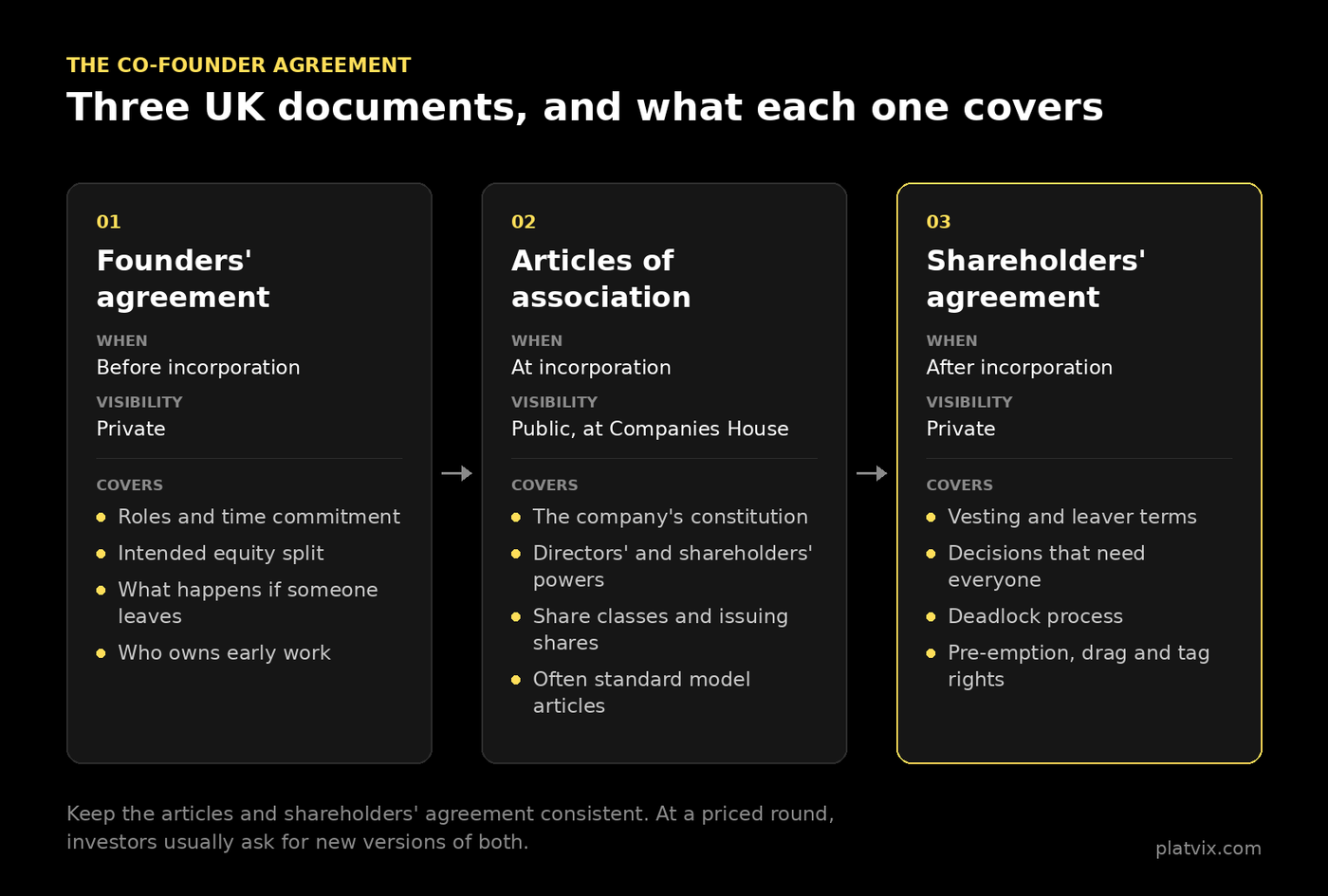
If you have already incorporated, or are about to, most UK lawyers suggest going straight to a shareholders' agreement and making sure it matches your articles. Where the two conflict, the result can be messy, so get them drafted together.
The Ten Things to Agree
1. Roles and responsibilities
Who leads on product, sales, fundraising and hiring, and who has the final say in each area. Titles matter less than clear ownership. Agree how you will revisit roles as the company grows, because the person who suits a job at three people may not suit it at thirty.
2. Time commitment
When each founder goes full-time, and what happens if someone does not. If one founder keeps a job for a while, agree the date or trigger for leaving it, such as closing a pre-seed round. Also agree whether anyone can keep side projects or advisory roles.
3. Equity split
How the shares are divided, and the reasoning behind it. Writing down why you chose the split helps if it is questioned later. Our guide on how to split equity between co-founders covers the main approaches.
4. Vesting
Vesting means founders earn their shares over time, so someone who leaves early does not keep a large stake for work they did not do. A common structure is four years with a one-year cliff, though UK lawyers also see three-year schedules and shorter cliffs. Founders who have already worked on the company for a while sometimes get credit for that time. See Founder Vesting Explained for the detail.
5. Leaver terms
What happens to a founder's shares when they leave. UK agreements usually separate good leavers, such as someone leaving through ill health, from bad leavers, such as someone dismissed for misconduct or leaving to join a competitor. Agree how each is defined, which shares the company or other founders can buy back, and at what price. Bad leavers often have to sell at nominal value or cost, while good leavers usually keep vested shares or sell them at market value.
6. Intellectual property
Everything created for the business, including code, designs and brand, should belong to the company, not to individual founders. This includes work done before the company existed. A separate IP assignment document transfers that earlier work into the company. Without one, a departing founder may still own part of your product.
7. Decisions and deadlock
Which decisions need all founders to agree, such as raising money, issuing new shares or selling the company, and which can be made by one person or a simple majority. With two equal founders, agree how you will break a deadlock: a trusted adviser as tie-breaker, mediation, or a casting vote for one founder on specific topics.
8. Pay and expenses
Whether founders take a salary, when that starts, and whether pay is equal. Agree how founders who cannot afford to go unpaid are handled, and how expenses are approved. Unequal pay is fine if both sides understand and agree to it.
9. Confidentiality and restrictions
Keeping company information confidential, and limits on a departing founder competing with the company or approaching its customers and staff. UK courts only enforce restrictions that are reasonable in length and scope and protect a genuine business interest, so take advice on what is enforceable.
10. Share transfers and exits
Rules on selling shares. These usually include pre-emption rights, which give existing shareholders first refusal on new or transferred shares. Drag-along rights let a majority require everyone to sell if the company is bought, and tag-along rights let minority holders join a sale on the same terms.
Conversations to Have Before You Sign
The agreement is only as good as the conversations behind it. Talk these through openly before anything is drafted:
What does success look like for each of us in five years, and would we sell the company if offered a good price?
How long can each of us go without a salary?
If one of us is not performing in their role, how do we raise it, and what happens next?
What would make either of us want to leave, and how much notice would we give?
What Investors Check When You Raise
During due diligence, pre-seed and seed investors typically look for:
- Founder shares that vest, so a founder who leaves soon after the round does not walk away with a large stake.
- Signed IP assignments from every founder and anyone else who built the product.
- A clean cap table, with no shares held by people who are no longer involved.
- Articles and a shareholders' agreement that do not conflict.
At a priced round, investors usually ask for new articles and a new shareholders' agreement that include their own rights. Your founder terms will be carried across or renegotiated, and investors sometimes ask founders to put vesting in place if there was none. Having it already agreed makes that step quicker.
How to Get It Done
Start by agreeing the commercial points between yourselves and writing them in a short summary. Then use an online legal platform or a startup solicitor to turn them into proper documents. Templates are a reasonable starting point at this stage, but have a solicitor check anything non-standard, especially leaver definitions and IP. Sign electronically, keep a copy each, and review the agreement whenever roles, equity or funding change.
Founder Checklist
- Have the four conversations above before drafting anything.
- Write a one-page summary of roles, equity, vesting and leaver terms.
- Sign IP assignments for all work done before incorporation.
- Put a shareholders' agreement in place and check it matches your articles.
- Agree a deadlock process if ownership is split equally.
- Set a date to review the agreement, such as before your first raise.
Common Mistakes
Waiting until there is a problem. Once a co-founder is unhappy or leaving, agreeing fair terms becomes much harder.
Issuing shares with no vesting. A co-founder who leaves after six months keeps their full stake, which can put investors off.
Forgetting pre-incorporation IP. Code written on a laptop before the company existed belongs to whoever wrote it until it is assigned.
Vague leaver definitions. If good and bad leaver are not clearly defined, you will argue about which applies at the worst possible time.
Articles that contradict the agreement. Keep the two consistent, and update both when anything changes.
FAQ
Do we need one if we are old friends splitting 50/50?
Yes, arguably more so. Friends often avoid hard conversations to protect the friendship, and an equal split with no deadlock process can leave the company stuck. Agreeing the terms early protects both the company and the relationship.
Can we sign something before incorporating?
Yes. A founders' agreement can record your intentions before the company exists. Once you incorporate, put a shareholders' agreement in place and assign any earlier IP to the company.
What if my co-founder does not want vesting?
Explain that vesting protects both of you, because it applies equally, and that most institutional investors will expect it. Giving credit for time already worked is a common compromise.
Where to Go From Here
- How to Split Equity Between Cofounders
- Founder Vesting Explained
- How to Find a Cofounder (Pre-Seed and Seed)
- Cap Table Basics
Closing Thought
A co-founder agreement is easiest to write when you least feel you need one. Spend an evening on the hard conversations, get the answers into a document your lawyer is happy with, and revisit it before you raise.
Getting Ready to Raise?
Once your founding team is on a solid footing, Platvix helps you prepare for investors:
- Analyses your deck against what investors look for at your stage
- Verifies the claims in your deck before investors check them
- Researches which UK and European firms are likely to back a company like yours
Get your deck analysed on Platvix →
Tags
- cofounder
- Vesting
- Equity-Split
- Founders
- Pre-seed
About the author
Zeeshan Ali, Co-Founder
Co-founder at Platvix, building an investment intelligence platform and the ecosystem around it so founders become investment-ready faster and VCs make stronger decisions. I focus on operations, partnerships, and community building, turning strategy into execution through programmes, processes, and founder support.