
The 10-Slide Pre-Seed Pitch Deck: What Each Slide Needs to Show
The ten slides every pre-seed deck needs, what investors check on each one, and the mistakes that cost founders meetings. Based on DocSend data on how investors actually read decks.

At pre-seed, your deck usually reaches an investor before you do. It gets a few minutes of attention, often on a phone, and decides whether you get a meeting. Most decks that miss do so for simple reasons: a problem that is hard to follow, a market slide built on one big number, or an ask that does not say what the money will achieve.
This guide covers the ten slides a pre-seed deck needs, what investors look for on each, and the most common mistake on each. It is written for UK and European founders raising their first round.
Data in this guide was checked against its sources in October 2026.
TL;DR
- Investors spend around four minutes on a pre-seed deck, according to DocSend. Each slide needs to make one point quickly.
- The business model and product slides get the most reading time. Make those two the clearest in the deck.
- If you have no revenue, show other evidence: paid pilots, letters of intent, or a waitlist that converts.
- End with a specific ask: how much, what it pays for, which milestones it reaches, and whether you have SEIS or EIS advance assurance.
- Keep a version to send that reads without you, and a lighter version to present.
How Investors Read a Pre-Seed Deck
DocSend, which tracks how people read shared documents, publishes data on pitch decks. In its pre-seed deck guide, updated in February 2026, investors spent an average of 4 minutes 10 seconds on a pre-seed deck. The most time went on the business model section (83 seconds) and the product section (77 seconds), followed by competition (55 seconds) and team (46 seconds). DocSend also estimates that only 1% to 2% of pre-seed decks sent to VCs lead to a meeting.
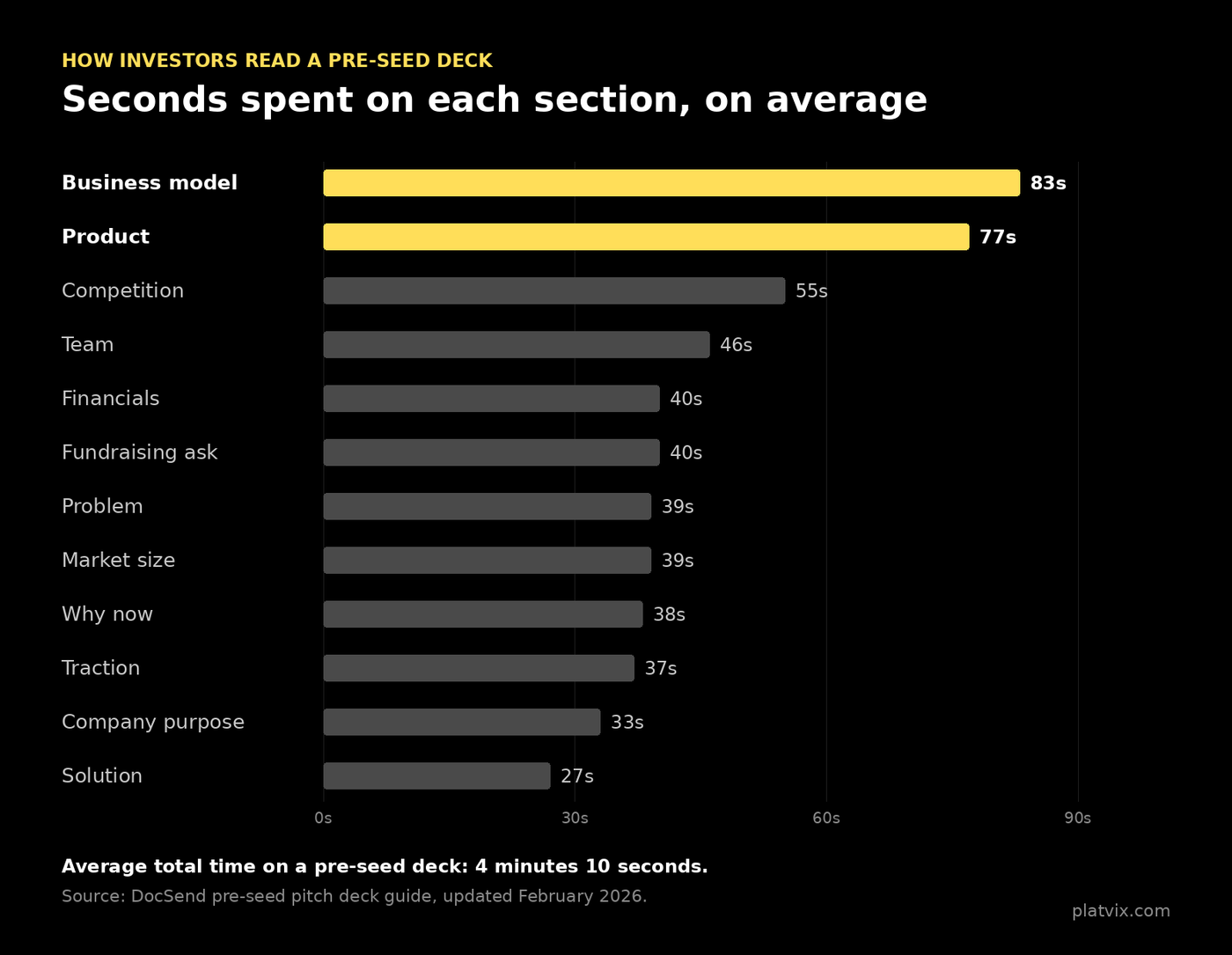
Two things follow from this. Every slide has to make its point in seconds, with a clear headline that states the takeaway. And the slides investors read most closely, how you make money and what you have built, deserve the most work.
DocSend's typical pre-seed deck runs to about 18 pages. The ten slides below are the core. Some, such as product, may need two pages, and anything else goes in an appendix.
1. Company Purpose
One sentence that says what you do and for whom, under your company name. An investor should be able to repeat it to a partner without looking at the deck again. For example: "We help UK accountancy firms close client books in half the time."
Common mistake: a vague mission statement such as "reimagining finance" that could describe hundreds of companies.
2. Problem
Who has the problem, how often, and what it costs them today in time or money. Name a specific customer type rather than "businesses" or "consumers". If you can, include a number from your own customer interviews, such as how many hours a week the problem takes.
Common mistake: describing an inconvenience that customers would not pay to fix.
3. Solution and Product
Show the product. Screenshots or a short walkthrough of the main workflow beat a list of features. Make it clear what the customer does differently after using it, and what you have actually built versus what is planned. This is one of the two slides investors read most closely, so it is worth two pages if you need them.
Common mistake: mock-ups presented as if they were a live product. Investors will ask, and it damages trust.
4. Why Now
What has changed recently that makes this possible or necessary: a new regulation, a shift in technology, a change in how customers buy. Investors use this slide to judge whether the opportunity is new or whether others have tried and failed for good reason.
Common mistake: naming a trend everyone already knows about, such as "AI is growing", without saying what it unlocks for your specific customer.
5. Market
Build the number from the bottom up: how many customers you could realistically reach, multiplied by what each would pay you a year. Show the calculation, and cite the source for each input. A bottom-up figure you can defend in a meeting is worth more than a large top-down figure from an industry report.
Common mistake: a single headline market size with no source. Market figures are among the claims investors most often check.
6. Competition
List the real alternatives your customers use today, including spreadsheets, agencies and doing nothing. Then explain, in a sentence or two, why customers would choose you. Investors spend nearly a minute on this slide, so be specific and fair to competitors.
Common mistake: saying you have no competitors. Investors read it as a sign you have not looked.
7. Business Model
How you make money: who pays, how much, how often, and what it costs you to serve them. This slide got the most reading time in DocSend's data, so make it easy to follow. If your pricing is still being tested, say what you charge today and what you have learned. Our guide to pricing your first product covers how to set and test it.
Common mistake: listing several possible revenue streams without saying which one you are pursuing first.
8. Traction or Evidence
Show the strongest evidence that customers want this. Revenue and its growth come first if you have them. If you are pre-revenue, use what you have, in roughly this order of strength:
- Paid pilots or pre-orders
- Signed letters of intent that name a price
- Free pilots with active, repeat usage
- A waitlist, with the share who took a next step such as booking a demo
- The number of customer interviews and what they told you
Common mistake: a chart with no labels or dates, or totals that hide that most users came in one launch week and did not come back.
9. Team
Why this team can build this company. For each founder, give the one or two facts that matter for this problem: relevant industry experience, what they have built before, or access to the first customers. Say who is full-time. At pre-seed, the team is often the main thing investors are backing.
Common mistake: a row of logos from past employers with no explanation of what each person did or why it is relevant.
10. The Ask
How much you are raising, the instrument (equity or an advance subscription agreement, for example), what the money pays for, and which milestones it gets you to before the next round. Investors want to see that the round is sized to reach something concrete, such as a revenue level or a product launch, rather than just a number of months of runway.
For UK rounds, say whether you have SEIS or EIS advance assurance from HMRC. Many UK angels will only invest in qualifying companies, so it is one of the first things they ask. Our SEIS and EIS guide explains how to get it.
Common mistake: a use-of-funds pie chart split into percentages with no link to milestones.
What Goes in the Appendix
Keep detail that supports the main slides but slows down a first read in an appendix at the back. Typical appendix material includes:
- A summary of your financial model and its key assumptions
- A detailed product roadmap
- A fuller competitor comparison
- Customer quotes or case studies
- Advisers and existing investors
The Version You Send and the Version You Present
A deck you send has to make sense without you there to explain it. Give each slide a headline that states its main point, and enough text for a reader to follow. A deck you present can carry less text, because you are doing the talking. Many founders keep two versions of the same deck for this reason.
Send the deck as a link rather than an attachment if you can. It lets you update it after sending, and some tools show which slides each investor read.
Questions to Test Your Deck Against
Could someone who has never met you explain what you do after reading only the first slide?
Does every number have a source or a calculation behind it?
Is it clear what is built today and what is planned?
Does the ask say what milestone the money reaches?
Founder Checklist
- Write a one-sentence headline for each slide that states its main point.
- Build your market size from the bottom up, with sources.
- Make the business model and product slides the clearest in the deck.
- Label every chart with units and dates.
- Tie the ask to milestones, and state your SEIS or EIS status.
- Ask two people outside your company to read it cold and explain it back to you.
Common Mistakes Across the Deck
Too much text in the presented version. If investors are reading, they are not listening to you.
Numbers that do not match. Different customer counts or revenue figures on different slides undermine everything else.
Projections presented as facts. Label forecasts clearly, and keep detailed projections in the appendix.
The same deck for every investor. A small change to the why-now or market slide to reflect an investor's focus can help it land.
FAQ
How many slides should a pre-seed deck have?
Cover the ten core slides first. DocSend's typical pre-seed deck runs to about 18 pages, because some topics take two. More than that usually means detail that belongs in an appendix.
Do I need financial projections at pre-seed?
Investors know early projections are estimates. What they want to see is that you understand the main drivers: price, cost to serve, how you acquire customers, and how much you need to spend to reach the next milestone. A simple model with clear assumptions in the appendix is enough.
Should I put a valuation in the deck?
Most founders leave it out and discuss it in meetings, because it is easier to negotiate in conversation. State the amount you are raising and the instrument instead.
Where to Go From Here
- How to Get Honest Feedback on Your Pitch Deck
- 5 Claims Investors Fact-Check in AI Pitch Decks
- Are You Actually Ready to Raise?
- How to Build Your Pre-Seed Investor List
Closing Thought
A pre-seed deck has a few minutes to earn a meeting. Give each slide one clear point, back every number with a source, and make the business model and product easy to follow. Then test it on people who have never heard your pitch before you send it to investors.
Check Your Deck Before Investors Do
Platvix helps you get your deck ready to send:
- Analyses each slide against what investors look for at pre-seed
- Verifies your market figures and other claims before investors check them
- Researches which UK and European firms are likely to back a company like yours
Get your deck analysed on Platvix →
Tags
- Pitch Deck
- Pre-seed
- Investors
- UK Fundraising
- SEIS
About the author
Zeeshan Ali, Co-Founder
Co-founder at Platvix, building an investment intelligence platform and the ecosystem around it so founders become investment-ready faster and VCs make stronger decisions. I focus on operations, partnerships, and community building, turning strategy into execution through programmes, processes, and founder support.