
How to Build a Pre-Seed Investor List That Actually Converts
Most pre-seed investor lists are mostly firms that were never going to invest. Here is how UK founders build a researched list: five filters, researching the partner, tiering, and where SEIS and EIS fit.

Most founders build their investor list the same way. They open a spreadsheet, paste in every fund they have heard of, add a few names from a newsletter, and start sending.
Then they wonder why a list of 150 firms produced three replies.
The list was never 150 real prospects. It was a small number of genuine fits hidden among firms which were never going to invest, because they write cheques at a different stage, in a different sector, or stopped making new investments from their current fund a year ago.
A good pre-seed list is not a longer list. It is a researched one. This is how to build it.
TL;DR
- A firm belongs on your list only if it invests at your stage, in your sector, at your cheque size, and has done so recently.
- A fund's website is often out of date. Its last six to twelve months of deals tell you what it does now.
- Research the partner, not just the firm. Early-stage decisions often start with one person getting interested.
- Tier the list and pitch your best-fit firms last, once the story has been tested.
- UK founders should mark which investors use SEIS and EIS, because it changes who says yes at pre-seed.
Why Most Investor Lists Fail Before the First Email
Built from fame. The funds everyone has heard of are mostly writing larger cheques at later stages. Being well known is not evidence that a firm backs pre-seed companies.
Built from a stale source. Funds change focus, raise new vehicles, lose partners and move up-market. A list copied from a directory reflects the firm as it was, not as it is.
Built from the label. "Early stage" on a website can mean anything from a first cheque at idea stage to a multi-million pound Series A. The label tells you almost nothing.
The Five Filters Every Firm Has to Pass
Run every name through these before it earns a place on the list.
1. Stage and cheque size. Look at the rounds it has actually led or joined. If its typical first cheque is several times your whole round, it is not a pre-seed investor, whatever the website says.
2. Thesis, in its own words. Read what the partners write and say: blog posts, LinkedIn, podcast appearances, fund announcements. Note the specific language. A fund which talks about vertical software for regulated industries is telling you exactly what it wants.
3. Recent activity. Check its deals from the last six to twelve months. A firm which has not made a new investment in a year may be late in its fund and reserving capital for existing companies.
4. Lead or follow. Some firms set terms and anchor rounds. Others only join once a lead exists. You need at least one of the first kind, and you should know which is which before you ask.
5. Portfolio conflicts. If a firm has backed a direct competitor, it will very likely pass. Check the portfolio before you send your deck anywhere.
Smaller funds are often where pre-seed cheques come from now. Our guide to micro-funds and solo GPs covers how they differ.
Research the Partner, Not Just the Firm
At pre-seed, a decision often starts with one partner getting interested. Which person covers your sector matters as much as the firm.
Find the partner whose investments sit closest to yours. Read what they have written or said recently. Note one specific thing which connects their interest to your company. That note becomes the first line of your outreach, and it is the difference between a message which gets read and one which gets archived.
If you cannot find a specific reason a named partner would care, the firm belongs lower on your list. For writing the message itself, see cold outreach that actually works.
Tier the List, Then Sequence It
Tier A. Strongest fit on every filter, with a partner who has backed something close to you. Usually a small group.
Tier B. Good fit on most filters. The bulk of your list.
Tier C. Plausible but weaker fit. Useful for testing the pitch.
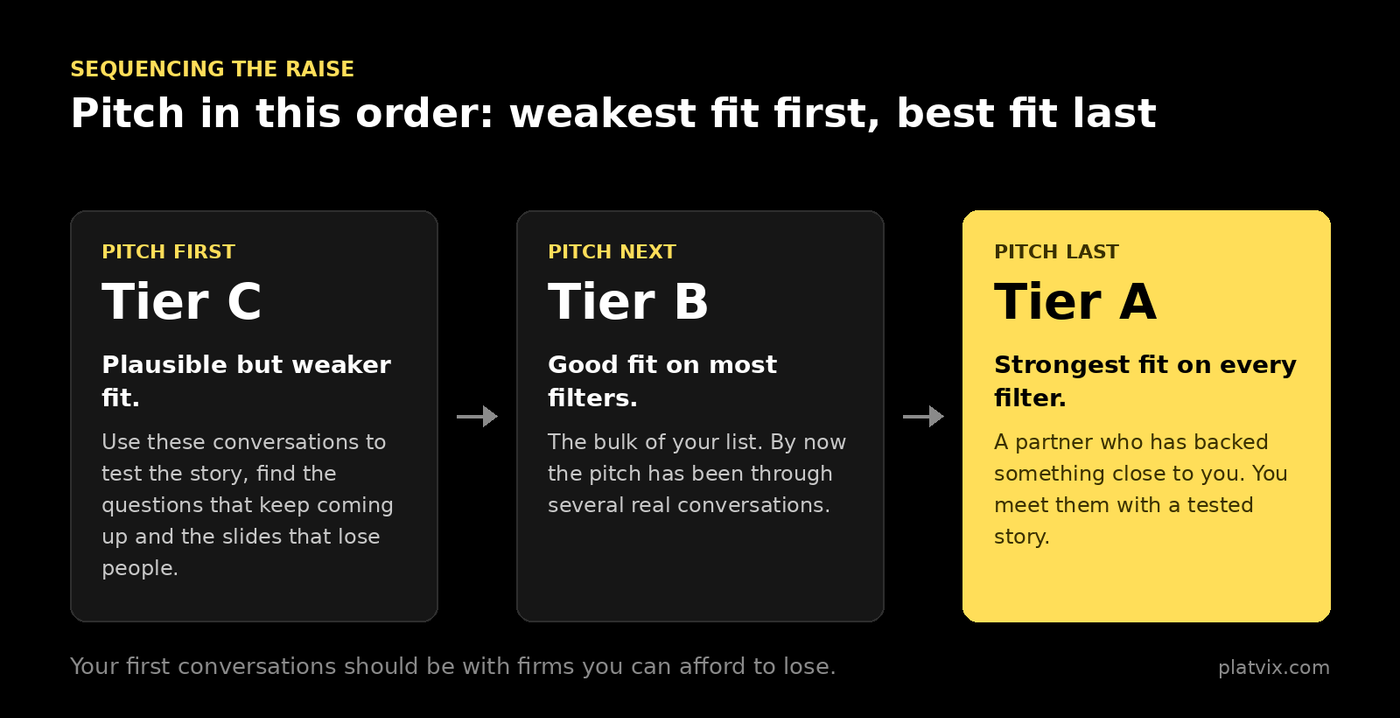
Start with tier C and the lower end of tier B. You will learn which questions come up, which slides lose people and which claims need more support. By the time you reach tier A, the story has been tested on firms you could afford to lose. If you have not yet checked whether you are ready at all, start with the pre-seed readiness check.
The UK Layer: SEIS, EIS and Angels
Angels and angel syndicates are often the first money into UK pre-seed rounds, and many of them invest because of SEIS and EIS relief.
Mark on your list which investors typically use the schemes, including funds which run dedicated SEIS or EIS vehicles. If your company qualifies and you have advance assurance, those investors are far more likely to move. If you do not qualify, knowing that early saves you conversations which were always going to stall. Our piece on why SEIS and EIS are leverage, not paperwork covers how to use them in the raise.
Angel networks and syndicates belong on the list from the start, not as an afterthought. At this stage they can move faster than institutional funds.
What a Good List Entry Looks Like
Firm and partner: the firm, and the person who covers your sector.
Typical first cheque: taken from recent deals, not the website.
Last relevant deal: the company, and when.
Leads or follows: based on their recent rounds.
Thesis note and why you: one line in their words, one line on the connection.
SEIS/EIS and tier: yes, no or unknown, and A, B or C.
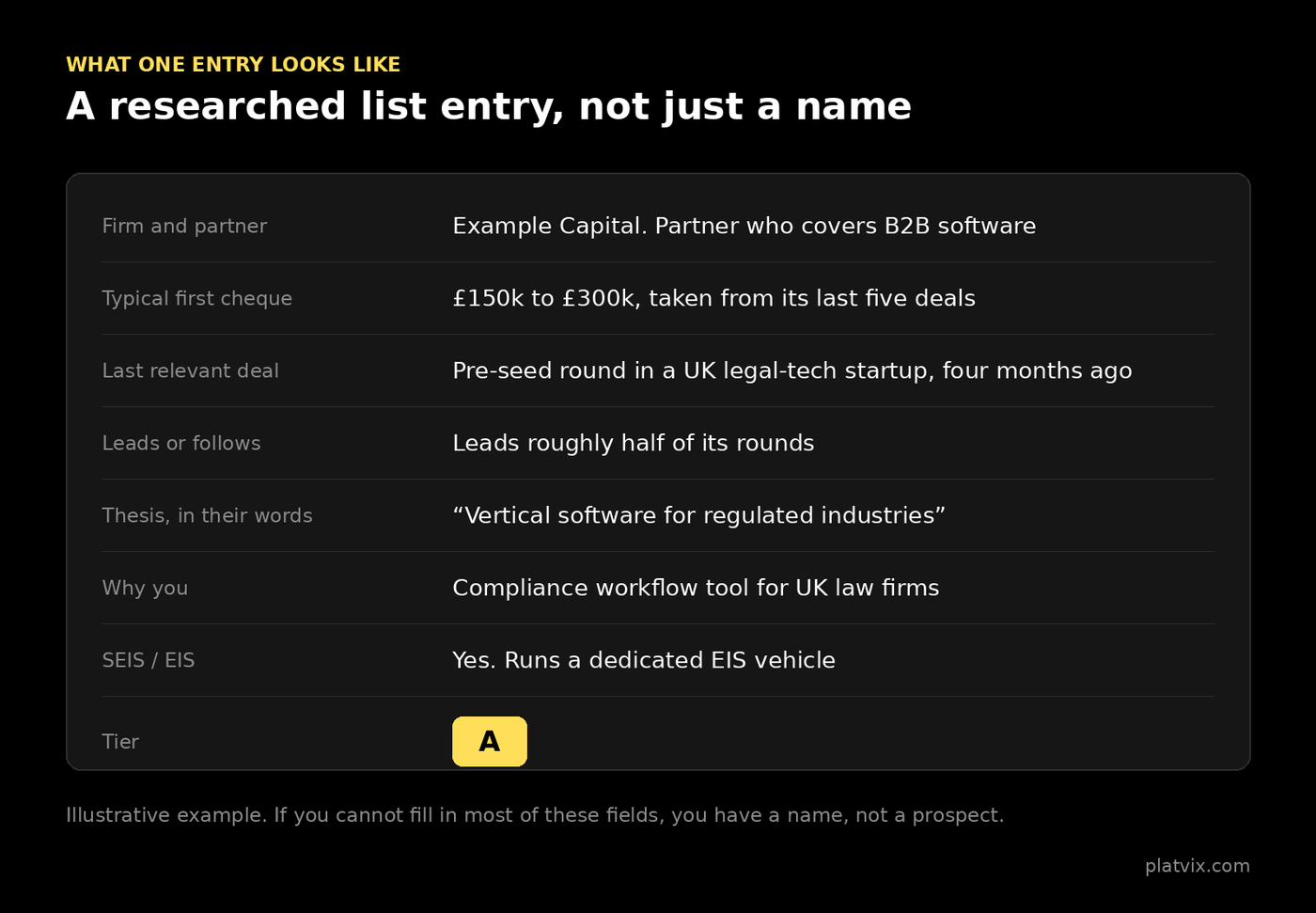
If you cannot fill in most of these fields, you have a name, not a prospect.
Founder Checklist
- Remove every firm whose recent first cheques are larger than your whole round.
- Check each firm's new investments over the last six to twelve months.
- Name the specific partner who covers your sector at each firm.
- Write one line on why each partner would care, in their own terms.
- Mark lead or follow, and confirm you have enough potential leads.
- Tag SEIS and EIS investors, then tier the list and plan to pitch tier A last.
Common Mistakes
Confusing a long list with a good one. Volume hides the fact that most names were never going to invest.
Trusting the website. Stated stage and sector drift. Recent deals are the evidence.
Only listing followers. A round made up of firms waiting for a lead does not close.
Emailing the firm, not a person. Generic inboxes are where outreach goes to wait.
Building the list once. Firms change while you raise. Refresh the list, especially if the process runs past a few months.
FAQ
How many investors should be on a pre-seed list?
Enough that you can afford a low hit rate. For most pre-seed rounds that means dozens of well-researched firms and angels, rather than a handful or several hundred. Fit matters more than the count.
How do I know if a fund is still actively investing?
Look at its announced deals over the last six to twelve months and any news of a new fund. A long gap with no new investments often means the current fund is mostly reserved for follow-ons.
Should I contact more than one partner at the same firm?
Generally no. Pick the partner closest to your sector. Contacting several at once tends to look scattered, and partners talk to each other.
Where to Go From Here
- Are You Actually Ready to Raise?
- Micro-Funds and Solo GPs
- SEIS/EIS Is Leverage, Not Paperwork
- Cold Outreach That Actually Works
- UK vs US Fundraising
Closing Thought
Most founders treat the investor list as admin, something to get through before the real work of pitching.
It is the real work. Every hour spent confirming that a firm invests at your stage, in your sector and right now saves a conversation which was never going anywhere, and protects the leads which might.
Research first. Then send.
Let the Research Run in the Background
Building this list by hand takes weeks, and it goes stale while you pitch. Platvix does the research for you:
- Researches which UK and European firms are likely to back a company like yours, based on each firm's stated thesis and recent activity
- Keeps track of fund news, new vehicles and shifts in focus, so your list reflects firms as they are now
- Scores your deck against what investors look for at your stage
- Drafts outreach grounded in what each firm actually invests in
Spend your time on the conversations, not the spreadsheet.
Start your investor research on Platvix →
Tags
- Pre-seed
- Investors
- UK Fundraising
- Fundraising
- SEIS
About the author
Zeeshan Ali, Co-Founder
Co-founder at Platvix, building an investment intelligence platform and the ecosystem around it so founders become investment-ready faster and VCs make stronger decisions. I focus on operations, partnerships, and community building, turning strategy into execution through programmes, processes, and founder support.