
Contractor or Employee? Hiring Your First People in the UK
Most UK startups start with contractors. Here is how employment status actually works, what IR35 means for a small company, the IP gap investors look for, and what your first employee needs from day one.

Most early teams in the UK start with contractors. A freelance developer builds the first version, a designer helps with the brand, and someone part-time handles the books.
That is usually a sensible way to start. The trouble comes later, when the arrangement has quietly turned into a job, or when an investor asks who owns the code and the answer is unclear.
This guide covers how UK employment status works, what IR35 means for a small startup, the intellectual property gap that shows up in due diligence, and what you need in place before your first employee starts.
General guidance, not legal or tax advice. Employment rules are changing through 2026 and 2027, and some dates may move. Speak to an employment lawyer or accountant before you act. Current as of September 2026.
TL;DR
- Employment status depends on how the work actually happens. Calling someone a contractor in the contract does not settle it.
- Most early-stage startups count as small companies under IR35, which means a contractor working through their own limited company decides their own status.
- Work created by a contractor usually belongs to the contractor unless they assign it to you in writing. Investors check this.
- Your first employee brings fixed obligations: PAYE registration, a right to work check, a written statement, insurance and a workplace pension.
- The Employment Rights Act 2025 is adding new rights in stages, including a shorter qualifying period for unfair dismissal from January 2027.
How Employment Status Works
UK law recognises three broad categories: employees, workers, and the self-employed. Each carries different rights and different obligations for you.
What decides the category is the reality of the working relationship. Tribunals and HMRC look at questions like these:
- Control. Do you decide how, when and where the work is done?
- Substitution. Could they send someone else to do the work, or must it be them personally?
- Obligation. Are you expected to keep offering work, and are they expected to accept it?
- Integration. Do they attend your team meetings, use a company email address and appear on your website as part of the team?
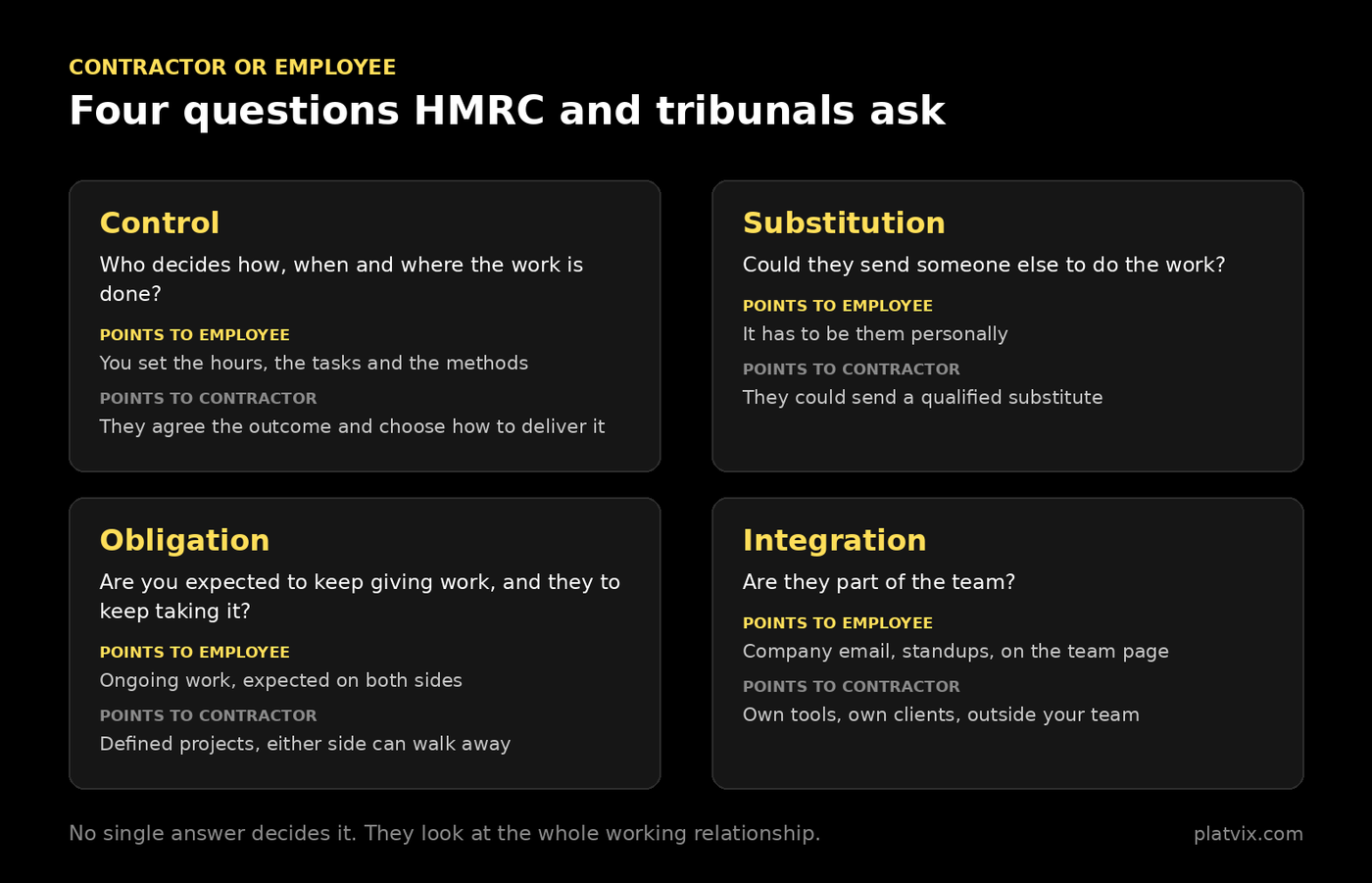
A freelancer who works full-time for you for a year, on your schedule, in your standups, looks a lot like an employee whatever the contract says. GOV.UK sets out the employment status categories, and HMRC's Check Employment Status for Tax tool gives a view on specific arrangements.
When a Contractor Makes Sense, and When It Does Not
Contractors suit work with a clear scope and an end point: building a prototype, a brand identity, a security review, bookkeeping a few hours a month. They are also useful when you cannot yet commit to a salary, or when you want to work with someone before offering them a permanent role.
An employee usually makes more sense when the role is ongoing and central to the company, when you need to direct the work day to day, or when you want the person to hold options and stay for years. Your first engineer or first salesperson usually falls into this group.
If you are still deciding which role to fill first, start with your first hire at a pre-seed startup.
What IR35 Means for a Small Startup
IR35 covers contractors who work through their own limited company. It asks whether they would be an employee if they were engaged directly, and if so, they should pay broadly the same tax as an employee.
Since 2021, medium and large clients have had to decide their contractors' status themselves. Small clients are exempt from that responsibility, and in that case the contractor's own company decides.
From April 2026 the thresholds for being small rose to £15 million turnover and £7.5 million balance sheet, with the 50-employee limit unchanged. A company that is not part of a group is treated as small in its first financial year and stays small until it exceeds two of the three thresholds for two consecutive years. Because the test looks back at earlier years, the new figures take effect in practice from 2027.
For almost every pre-seed and seed startup, that means the contractor decides their own IR35 status. Two cautions still apply. If you are part of a larger group, different rules may apply. And if you hire a sole trader directly rather than through their limited company, IR35 does not apply at all, but HMRC can still treat the person as your employee if the relationship looks like employment, which can leave you owing tax and National Insurance.
The IP Gap Investors Look For
Under UK law, work an employee creates in the course of their job generally belongs to the employer. Work a contractor creates generally belongs to the contractor, unless they assign it to you in writing.
Many startups find this out during due diligence. The first version of the product was built by a freelancer on a handshake, there is no assignment, and the company cannot show it owns its own code. The fix is usually a short assignment document, but it is far easier to get signed while the relationship is friendly than after it has ended.
Every contractor agreement should include an IP assignment and confidentiality terms. If you already have work from past contractors without one, get it assigned now.
Before Your First Employee Starts
GOV.UK has a full guide to employing staff for the first time. The core steps:
- Register as an employer with HMRC and set up PAYE before the first payday.
- Check their right to work in the UK before they start.
- Give a written statement of employment particulars on or before their first day.
- Take out employers' liability insurance, which most employers are legally required to hold.
- Set up a workplace pension and enrol eligible staff automatically.
- Pay at least the National Minimum Wage for their age band.
The Employment Rights Act 2025 is also changing what employees are entitled to. Since April 2026, statutory sick pay has been payable from the first day of illness, and paternity leave and unpaid parental leave have been available from day one. From 1 January 2027, the qualifying period for unfair dismissal is due to fall from two years to six months, so probation periods and early performance conversations matter more. Acas keeps a current summary of the changes.
What Investors Check in Diligence
Signed agreements for every employee and contractor who has worked on the product.
IP assignments from founders and contractors, so the company owns what it sells.
Documented option grants, so every equity promise made to an early hire is written down.
No obvious status risk, such as a long-term full-time contractor who is an employee in everything but name.
Founder Checklist
- List everyone who has worked on the product and the basis they worked on.
- Get IP assignments signed for any past contractor work without one.
- Review any contractor who has been full-time for months against the status questions above.
- Register for PAYE and arrange insurance and a pension scheme before your first employee starts.
- Write down every equity promise and put it through a proper option scheme.
Common Mistakes
Relying on the contract label. If someone works like an employee, calling them a contractor will not change how HMRC or a tribunal sees it.
Skipping the IP assignment. It is the easiest document to get signed at the start and the hardest to get later.
Promising equity in a message. An informal promise of shares can turn into a dispute or a diligence problem. Formalise it.
Leaving admin until payday. PAYE registration, the right to work check and insurance all need to be in place before the first day or the first payment.
FAQ
Does IR35 apply to my startup?
If your company is small and not part of a larger group, the 2021 off-payroll rules do not put the status decision on you. A contractor working through their own company makes that decision. Check with an accountant if you are part of a group or growing quickly.
Can I give a contractor share options?
You can, but EMI options, the most tax-efficient UK scheme, are generally only available to employees who meet working-time conditions. Contractors usually receive unapproved options instead. See employee equity for early hires.
When should a contractor become an employee?
When the work has become ongoing, you direct it day to day, and they are effectively part of the team. That is usually the point to make the role permanent and fund it properly.
Where to Go From Here
- Your First Hire at a Pre-Seed Startup: Engineer vs Sales vs Ops
- Employee Equity for Early Hires
- Technical Cofounder vs CTO Hire
- How to Build Your Startup Team at Pre-Seed and Seed
Closing Thought
Early hiring decisions are made quickly, usually by founders who have plenty else to do. That is fine, as long as the paperwork keeps up with the reality: the right status for how someone actually works, an IP assignment for everything built for you, and the basic employer steps done before day one.
An afternoon spent on this now saves a much longer conversation with an investor's lawyers later.
Raising to Fund Your First Hires?
Platvix helps founders prepare the raise that pays for the team:
- Analyses your deck, including how your team and hiring plan read to an investor
- Verifies the claims in your deck before investors check them
- Researches which UK and European firms are likely to back a company like yours, based on each firm's stated thesis and recent activity
Get your deck analysed on Platvix →
Tags
- Hiring
- compliance
- Pre-seed
- Founders
About the author
Zeeshan Ali, Co-Founder
Co-founder at Platvix, building an investment intelligence platform and the ecosystem around it so founders become investment-ready faster and VCs make stronger decisions. I focus on operations, partnerships, and community building, turning strategy into execution through programmes, processes, and founder support.