
How to Get Warm Investor Intros When You Have No Network
Every fundraising guide says get a warm intro. Few say where from if you know nobody. Here is how UK founders build intro paths from zero, who can actually introduce you, and how to ask.

Every piece of fundraising advice says the same thing: get a warm introduction.
Very little of it says where that introduction is supposed to come from if you are a first-time founder in Leeds, Belfast or Cardiff who has never met an investor.
A warm intro only requires you to know someone an investor already trusts. You can build that list deliberately in the months before you raise.
TL;DR
- A warm intro works because someone the investor trusts has put a little of their reputation behind you.
- The strongest intros usually come from founders the investor has already backed.
- You build intro paths by working backwards from your target list, one firm at a time.
- Make every intro easy to give: a short, forwardable email and a double opt-in.
- A weak intro can do more harm than a sharp cold email. When there is no real path, go cold and do it well.
Why Warm Intros Work (and When They Do Not)
Investors see far more companies than they can meet. An introduction is a filter. When someone they respect says "you should talk to this founder", they are saying they have already done a little of the screening.
That only works if the person introducing you actually knows your work. An intro from someone who met you once, forwarded with "not sure if this is for you", tells the investor the opposite of what you want. It says nobody close to the company was willing to vouch for it.
What you want is an introduction from someone whose judgement the investor trusts and who can say something specific about you.
Who Can Actually Introduce You
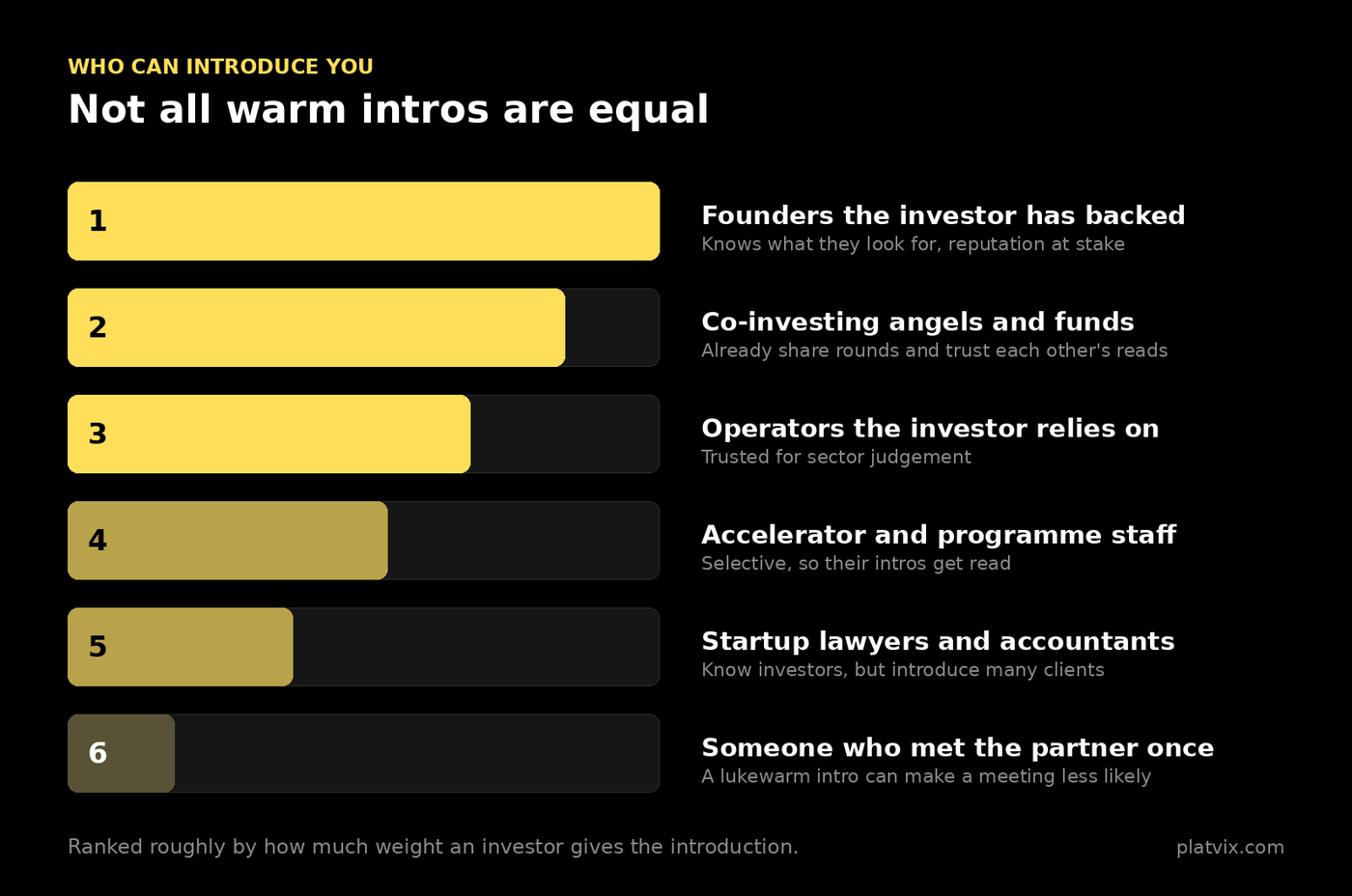
Roughly from strongest to weakest:
1. Founders the investor has backed. Investors listen closely to their own portfolio founders, because those founders know what the investor looks for and have their own reputation at stake. This is usually the best path available.
2. Angels and funds who co-invest with them. Investors who regularly share rounds trust each other's early reads. If an angel is already interested in you, ask whether they know the funds you are targeting.
3. Operators and advisers the investor relies on. Many investors lean on experienced operators for sector knowledge. If one of them rates you, that carries weight.
4. Accelerator and programme staff. People who run programmes see many companies and send investors a steady stream of them. They introduce selectively, so their intros tend to get read.
5. Startup lawyers and accountants. Firms which work with early-stage companies often know investors well. Useful, but they introduce many clients, so the signal is weaker.
6. Someone who met the partner once. Usually not worth using. A lukewarm intro from a loose connection can make an investor less likely to meet you.
Building Intro Paths From Zero
Start from your target list and work backwards. If you have not built one yet, start with how to build a pre-seed investor list. Then, for each firm in your top two tiers:
Map the portfolio. List the founders of companies the firm has backed in the last two or three years, especially any close to your sector or stage.
Check your second degree. Look for mutual connections on LinkedIn with those founders and with the partner. Former colleagues, university contacts and people from your sector count.
Go where founders are. Regional founder meetups, sector communities, accelerator demo days and online founder groups. Outside London, local ecosystems are often smaller and easier to get to know properly.
Give before you ask. Offer other founders something useful: a customer introduction, honest feedback on their product, a hire you know. The founders who later introduce you are usually the ones you helped first.
Expect this to take a few months, so start well before the raise, while you are still building. Investors are also easier to meet before you need their money.
How to Ask for the Intro
Talk before you ask. Never open a conversation with a portfolio founder by asking for an introduction. Ask for twenty minutes to learn how they raised and what the investor is like to work with. If they rate you, they will often offer.
Use a double opt-in. Ask the person to check whether the investor wants the introduction before making it. Investors appreciate being asked, and it protects your connection's relationship with them.
Write the forwardable email for them. Send a short email your connection can forward without editing. It should make sense to someone who has never heard of you.
A forwardable email that works:
Hi [Name], thanks for offering to introduce me to [Partner] at [Firm]. Here is a short note you can forward.
[Company] helps [specific customer] [specific outcome]. We launched [when] and have [one concrete proof point: paying customers, pilots, growth]. We are raising [amount] at pre-seed and I think [Firm] could be a good fit because [one specific reason tied to their recent investments or stated thesis]. Deck attached. Happy to share more if useful.
Keep it to five or six lines. Your connection should be able to forward it in thirty seconds.
When Cold Is the Right Move
If there is no real path to a firm within two degrees, do not force one. A specific, well-researched cold email to the right partner beats a vague introduction from someone who barely knows you. Some funds also accept decks directly through their website. Our guide to cold outreach that actually works covers how to write one.
A good cold email and a good warm intro need the same two things: a clear reason why this firm, and one piece of proof.
Intro Strength at a Glance
Strong: a portfolio founder who knows your work and offers to introduce you.
Good: a co-investing angel, a trusted operator, or programme staff who have seen you up close.
Neutral: a well-researched cold email to the right partner.
Weak: an intro from someone who met the partner once and cannot say anything specific about you.
Founder Checklist
- List the portfolio founders of every tier A and tier B firm on your list.
- Mark your second-degree connections to each founder and partner.
- Book learning conversations with founders months before you raise.
- Offer something useful to other founders before asking for anything.
- Write one forwardable email per firm, tied to that firm's thesis.
- Decide in advance which firms you will approach cold, and do it properly.
Common Mistakes
Asking strangers for intros. A founder you have never spoken to has no reason to spend their credibility on you, and the request makes that obvious.
Accepting every offered intro. If the person cannot say anything specific about you, politely decline and approach that firm another way.
Making your connection do the writing. If they have to draft the intro, it will be vague or it will not happen.
Using your best path on the wrong firm. Save your strongest connections for tier A firms, once the pitch has been tested.
Starting the week you need money. Relationships built under pressure feel transactional to everyone involved.
FAQ
Do I need a warm intro to raise pre-seed?
No. It usually helps, but plenty of founders raise from cold outreach, especially from angels and smaller funds. A sharp cold email to a well-matched firm is better than no contact at all.
How do I ask a portfolio founder for an intro without being awkward?
Do not ask at first. Ask to learn from their raise. If the conversation goes well and you are a genuine fit, they will often offer. If they do not, you have still learned how that investor thinks.
What if I am based outside London?
Regional ecosystems are often an advantage for this. They are smaller, so it is easier to become known to the people who matter, and regional angels and funds tend to know each other well.
Where to Go From Here
- How to Build a Pre-Seed Investor List That Actually Converts
- Cold Outreach That Actually Works
- Are You Actually Ready to Raise?
- Micro-Funds and Solo GPs
- SEIS/EIS Is Leverage, Not Paperwork
Closing Thought
Most founders with a strong network built it gradually, usually by being useful to other founders long before they needed anything back.
Start with the firms on your list and get to know the founders they have backed. Introductions usually come out of those conversations.
Know Which Doors to Knock On
Intro paths start with the right firms. Platvix does that research for you:
- Researches which UK and European firms are likely to back a company like yours, based on each firm's stated thesis and recent activity
- Shows what each firm has been investing in lately, which is where your best intro paths start
- Drafts outreach grounded in what each firm actually invests in, whether you go warm or cold
Start your investor research on Platvix →
Tags
- Pre-seed
- Investors
- UK Fundraising
- Fundraising
- Angel investing
- outreach
About the author
Zeeshan Ali, Co-Founder
Co-founder at Platvix, building an investment intelligence platform and the ecosystem around it so founders become investment-ready faster and VCs make stronger decisions. I focus on operations, partnerships, and community building, turning strategy into execution through programmes, processes, and founder support.