
How to Price Your First Product: A Practical Guide for Early-Stage Founders
How to choose what you charge for, set a starting price before you have much data, test it with real customers, and know when to change it. With UK VAT and pricing rules covered.

Most founders put off pricing. It feels like a decision you should only make once you have usage data, competitor research and a few hundred customers. In practice you need a price long before any of that, because the first serious customer conversation ends with the question "how much is it?"
Your first price will be a reasoned guess that you test and adjust. This guide shows how to make that guess well: what to charge for, how to set a starting number, how to test it in conversations, and when to change it. It is written for founders selling software, including AI products, mainly to businesses.
Figures and rules in this guide were checked against their sources in October 2026.
TL;DR
- Decide what you charge for before you decide how much. The unit you charge on shapes everything else.
- Start from what the problem costs your customer, then check the price covers your own cost to serve with room to spare.
- Start higher than feels comfortable. If every prospect agrees without hesitation, your price is probably too low.
- Test price in live sales conversations, and keep a written list price even when you give early customers a discount.
- Expect to change it. Most software companies changed pricing or packaging in the last year.
Why Your First Price Matters
Pricing changes often, even at established companies. In Kyle Poyar's 2026 State of B2B Monetization report, a survey of more than 230 software and AI companies, three in four had changed pricing or packaging within the previous year. So you do not need to get it perfect first time.
The first price still matters, for three reasons. It anchors what early customers expect to pay, which makes later increases harder if you start very low. It decides which customers you attract, since a very cheap product draws buyers who will not pay more later. And it is evidence for investors: a customer paying a real price tells them far more than a free pilot does.
Step 1: Decide What You Charge For
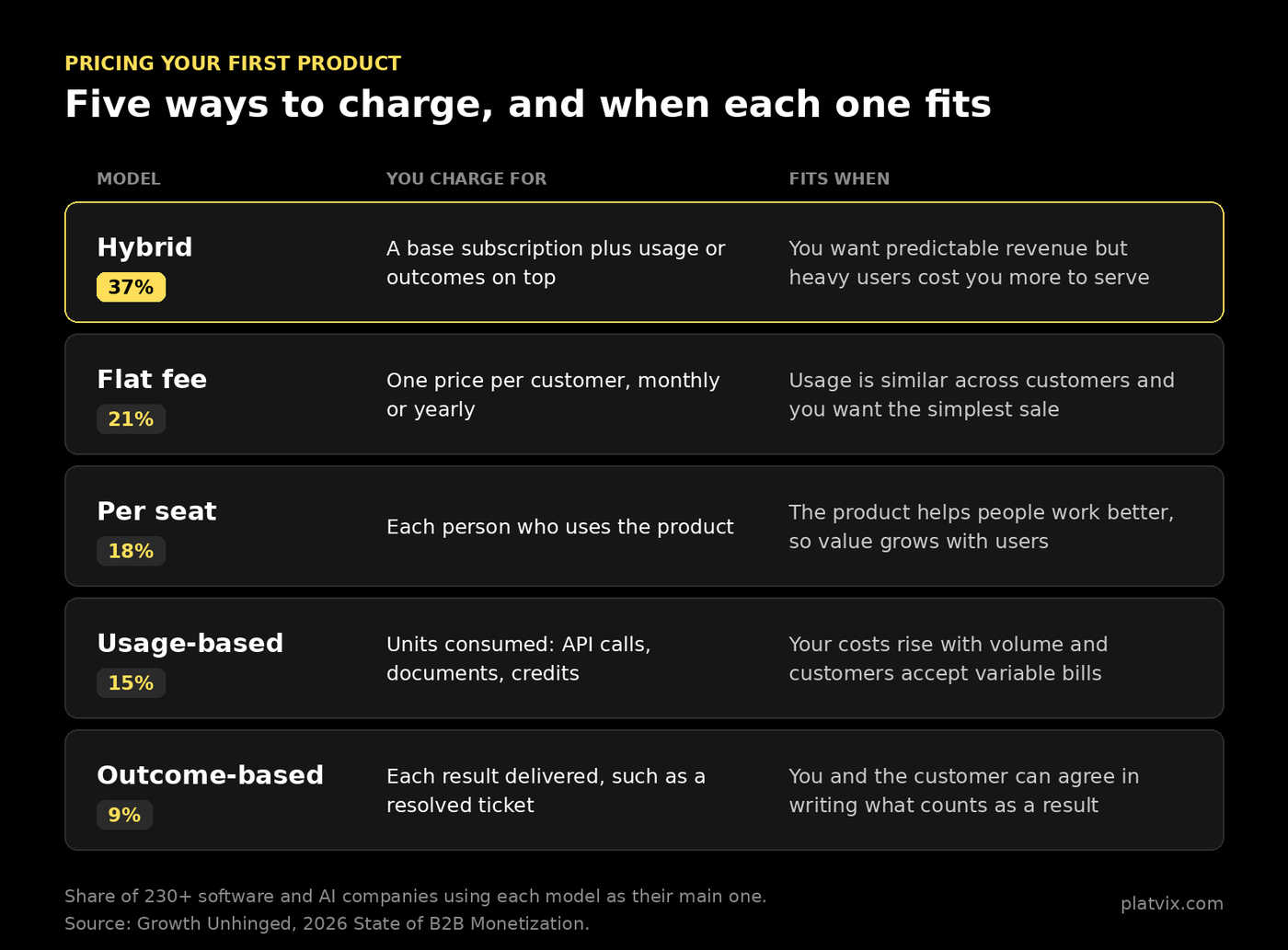
Before you pick a number, pick the unit. This is sometimes called the value metric: the thing your price goes up with. The main options are:
- Flat fee: one price per customer per month or year. Simple to sell and to forecast.
- Per seat: a price for each user. Grows as the customer adds people.
- Usage-based: a price per unit consumed, such as API calls, documents processed or credits.
- Outcome-based: a price per result delivered, such as a resolved support ticket or a booked meeting.
- Hybrid: a base subscription plus a usage or outcome element on top.
Hybrid pricing is now the most common model. In the same 2026 survey, 37% of companies used hybrid pricing, up from 25% a year earlier, followed by flat fees at 21%, per seat at 18%, usage-based at 15% and outcome-based at 9%.
How to choose: per-seat pricing suits products that help people do their work better, because value grows with the number of people using it. If your product replaces work people used to do, charging per seat can mean you earn less as you succeed. Usage-based pricing suits products whose costs rise with volume, such as many AI products, but Bain Capital Ventures notes it can frustrate buyers with constant purchasing decisions and unpredictable invoices. Outcome-based pricing only works when you and the customer can agree, in writing, on what counts as an outcome.
At pre-seed, a flat fee or a simple base fee with a usage allowance is usually easiest. You can move to a more complex model once you know how customers actually use the product.
Step 2: Work Out What the Problem Costs Your Customer
Competitor prices and your own costs both matter, but neither tells you what a customer will pay. Start with what the problem costs them today: staff time, lost revenue, errors, or the price of the tool or agency they use now. You will usually learn this in discovery calls if you ask directly.
A common rule of thumb, cited by the venture firm CRV, is that customers should get roughly ten times the value of what they pay. Treat it as a sense check rather than a formula.
An illustrative example. Say your tool saves a five-person finance team ten hours each a month, and their time costs the business around £40 an hour. That is about £2,000 a month of time saved. On the ten-times rule, a price of around £200 a month leaves the customer a clear gain. If your discovery calls show the team also avoids costly errors, the value and the room for a higher price both go up.
Then check your cost floor
Next, work out what each customer costs you to serve: hosting, third-party tools, support time and, for AI products, model and compute costs. AI products rarely reach the margins of traditional software. In the 2026 survey, the median target margin on AI products was 50%, and only 12% of companies aimed for the 80% or more typical of software. If a heavy user could cost you more than they pay, add a usage limit or a usage charge before you sign them.
Step 3: Start Higher Than Feels Comfortable
Founders tend to underprice, usually because they are worried about losing the deal. CRV's advice is to "start high and keep raising until you start losing a meaningful share of deals based solely on price". If every prospect agrees to your price without hesitation, it is probably too low.
It is much easier to give a discount from a higher list price than to raise a price customers already know. Some pushback on price is a healthy sign. Losing most deals on price alone means you have gone too far, or that you are talking to the wrong customers.
Step 4: Test the Price With Real Customers
The best test is a live sales conversation with someone who could actually buy. Asking "what would you pay?" in a discovery call gives you a polite guess. Quoting a real price and seeing what happens gives you evidence.
- Say the price plainly, then stop talking and let them respond.
- Ask what they would compare it to. Their answer tells you which budget it comes from and what they consider the alternative.
- Ask who else needs to approve it. A price that needs finance director sign-off sells more slowly than one a team lead can approve.
- Vary the price between prospects of a similar size, and record each reaction and outcome.
If you want survey data
Once you have enough prospects who understand the product, the Van Westendorp price sensitivity method asks four questions: at what price would this be so cheap you would doubt its quality, at what price would it be a bargain, at what price would it start to feel expensive, and at what price would it be too expensive to consider. Plotting the answers gives you an acceptable price range. It works best alongside sales conversations, because people answer surveys differently from how they buy.
Step 5: Keep Packaging Simple
Early on, two or three plans are enough, which matches CRV's guidance for companies before Series B. Each plan should be for a clearly different type of customer, such as a small team and a larger company, so buyers can see which one is theirs.
Discounts for early customers
Discounts for your first customers, sometimes called design partners, are normal. Handle them carefully:
- Show the full list price on the order form or contract, and the discount as a separate line.
- Give the discount an end date, such as the first twelve months.
- Ask for something in return: regular feedback calls, a case study or a reference for future customers.
- If you run a free pilot, agree its length and what would make the customer convert to a paid plan before it starts.
UK Rules to Know Before You Publish a Price
VAT. You must register for VAT once your taxable turnover passes £90,000 in a rolling twelve-month period. When selling to businesses, make it clear whether prices exclude VAT, as most B2B software prices do. Once you register, VAT-registered business customers can usually reclaim it, but consumers and unregistered businesses cannot, so the same list price costs them 20% more.
Consumer pricing. If you sell to consumers, the Digital Markets, Competition and Consumers Act has banned drip pricing since 6 April 2025. The price you show must include VAT and any mandatory fees from the start, rather than adding them at checkout. The CMA has been consulting on how this applies to fixed-term and recurring contracts, so check the current guidance if you sell subscriptions to consumers.
This is general information, not legal or tax advice. Speak to an accountant before you register for VAT or set consumer prices.
What Investors Want to See About Your Pricing
At pre-seed, investors are not expecting a finished pricing strategy. They want to see that someone pays, and that you have thought about how pricing grows. Be ready to answer:
- How many customers pay, and how much, without discounts hiding the real number.
- How you arrived at the price, and what you learned from testing it.
- Your gross margin per customer, especially if model costs rise with usage.
- How revenue per customer grows as they use more, add users or move to a bigger plan.
When to Change Your Price
Review pricing every few months in the early stages. Signs it is time to change:
- Nearly every prospect accepts without pushback.
- You keep losing deals to price alone, from customers who otherwise fit.
- Some customers use far more than others but pay the same.
- Your cost to serve has risen, or you have added features that deliver clear extra value.
When you raise prices, apply the new price to new customers first. Give existing customers notice and, if you can, keep their current price for a period. Early customers took a risk on you, and they are often your best references.
Questions to Ask in a Pricing Conversation
What does this problem cost you today, in time or money?
What would you compare this price to?
Whose budget would this come from, and who else needs to approve it?
What would need to be true for this to be an easy yes at this price?
Founder Checklist
- Choose the unit you charge on, and write down why.
- Estimate what the problem costs a typical customer each month.
- Calculate your cost to serve one customer, including model and compute costs.
- Set a list price above where you feel comfortable, and quote it in your next five sales calls.
- Record every reaction and outcome, and review the price after a month.
- Check whether your prices need to include or exclude VAT.
Common Mistakes
Pricing from your costs alone. Cost plus a margin tells you the minimum you can charge. It says nothing about what the product is worth to the customer.
Copying a competitor's price. Their price reflects their costs, customers and stage. Use it as one input, alongside what your discovery calls tell you.
Free pilots with no end date. Without an agreed end and conversion terms, pilots drift and you learn little about willingness to pay.
Unlimited usage on an AI product. If model costs rise with usage, one heavy customer can wipe out your margin. Set a usage allowance.
Too many plans. Five tiers with overlapping features slow buyers down. Two or three clear plans are enough at this stage.
FAQ
Should I offer a free plan?
Only if users can get value on their own, quickly, and serving free users costs you little. CRV puts typical freemium conversion at 1% to 10%, with most companies at 2% to 5%. If you sell to businesses through sales conversations, a time-limited trial or a paid pilot usually teaches you more.
Should I show prices on my website?
If customers can sign up without speaking to you, yes. If every deal involves a sales conversation and prices vary by customer size, showing a starting price is a useful middle ground: it filters out buyers who cannot afford you without fixing every deal.
How do I price an AI product when my costs are uncertain?
Use a base fee that includes a usage allowance, with a charge for usage above it. Track cost per customer from the first month, and review the allowance once you see real usage patterns.
Where to Go From Here
- What to Build After Your MVP
- What Investors Actually Look for in AI Startups (2026)
- Are You Actually Ready to Raise?
- Bootstrapping vs Raising: The 2026 Calculus
Closing Thought
Set a price you can explain, quote it to real buyers, and write down what happens. A few weeks of honest sales conversations will tell you more than any pricing model, and give you numbers you can show investors when you raise.
Show Investors the Evidence Behind Your Numbers
When you are ready to raise, Platvix helps you present your pricing and traction clearly:
- Analyses your deck against what investors look for at your stage
- Verifies the claims and numbers in your deck before investors check them
- Researches which UK and European firms are likely to back a company like yours
Get your deck analysed on Platvix →
Tags
- Pricing
- SAAS
- Revenue
- Customer Discovery
- Pre-seed
About the author
Zeeshan Ali, Co-Founder
Co-founder at Platvix, building an investment intelligence platform and the ecosystem around it so founders become investment-ready faster and VCs make stronger decisions. I focus on operations, partnerships, and community building, turning strategy into execution through programmes, processes, and founder support.