
Pre-seed buys clarity. Seed buys speed
How to know which round you're actually ready for.
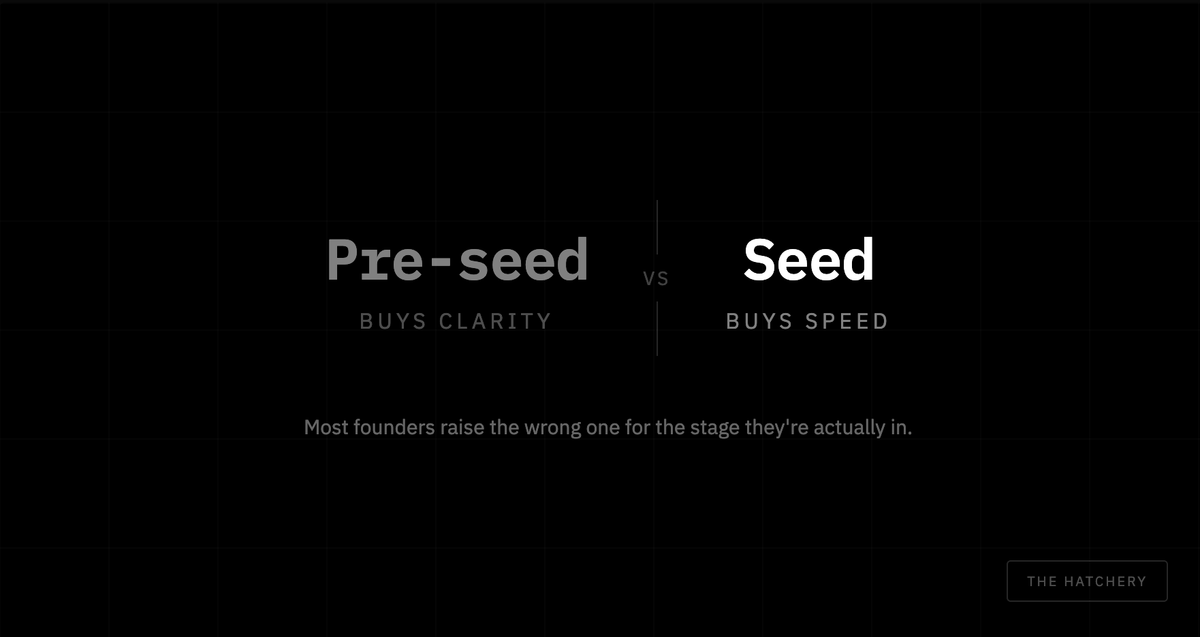
Pre-seed and seed are not the same round with different dollar signs. They are different contracts.
Most founders raise the wrong one for the stage they're actually in.
Scene 1: The trap
Founders raise "seed" because it sounds right. But they're still in pre-seed reality:
- The wedge keeps changing
- The buyer isn't clear
- Onboarding is different every time
- The story depends on future features
That round becomes expensive in expectations. The check clears, but the clock starts. Now there's a board. Now there are metrics. Now there's a timeline to Series A.
The other mistake is staying in pre-seed forever. SAFE after SAFE. "We'll keep it flexible." That stacks dilution and delays real decisions.
Carta data shows the cost: for every $1M–$1.9M raised on SAFEs, median expected dilution is 15.6%. Push that to $2M–$2.9M, and it jumps to 18.4%. Flexibility has a price.
Scene 2: What pre-seed is for
Pre-seed is for answering:
- Who is the user?
- What job are they hiring you for?
- What is the smallest version that helps?
- Why do they come back?
If those answers are still moving, that's normal. That's pre-seed.
The numbers reflect this. Median pre-seed round size is around $700K. Most rounds are under $1M. The goal isn't scale. It's signal.
Pre-seed traction = proof the wedge is real. A small group keeps coming back. The problem is urgent. The workflow is clear.
Also: 92% of pre-seed rounds use SAFEs. The standard structure: post-money with a valuation cap, no discount.
Scene 3: What seed is for
Seed is for turning clarity into a company:
- Can this repeat?
- Does onboarding look similar across customers?
- Can the product work without heroics?
- Can you hire into a plan?
Seed is not "we have a product." Seed is "we know what to build, who it's for, and how it gets adopted."
Seed traction = proof it's repeatable. Onboarding repeats. Usage holds. The product has a default shape, not ten custom versions.
What traction means at each stage
Pre-seed traction:
- A small group keeps coming back
- The problem is urgent
- The workflow is clear
- You can describe the wedge without hedging
Seed traction:
- Onboarding repeats
- Usage holds across cohorts
- The product has a default path
- You can hire into a plan
The difference isn't revenue. It's repeatability.
How much to take
Two realities:
Pre-seed:
- Median dilution: 10–15% depending on round size
- $1M–$1.9M raised → 15.6% median dilution
- $2M–$2.9M raised → 17.8% median dilution
Seed:
- Founders typically sell ~20%
- Median round: $4M at $20M post-money
- AI startups command higher valuations (~$19M vs. $15M market median)Typical founder dilution path from start to Series A
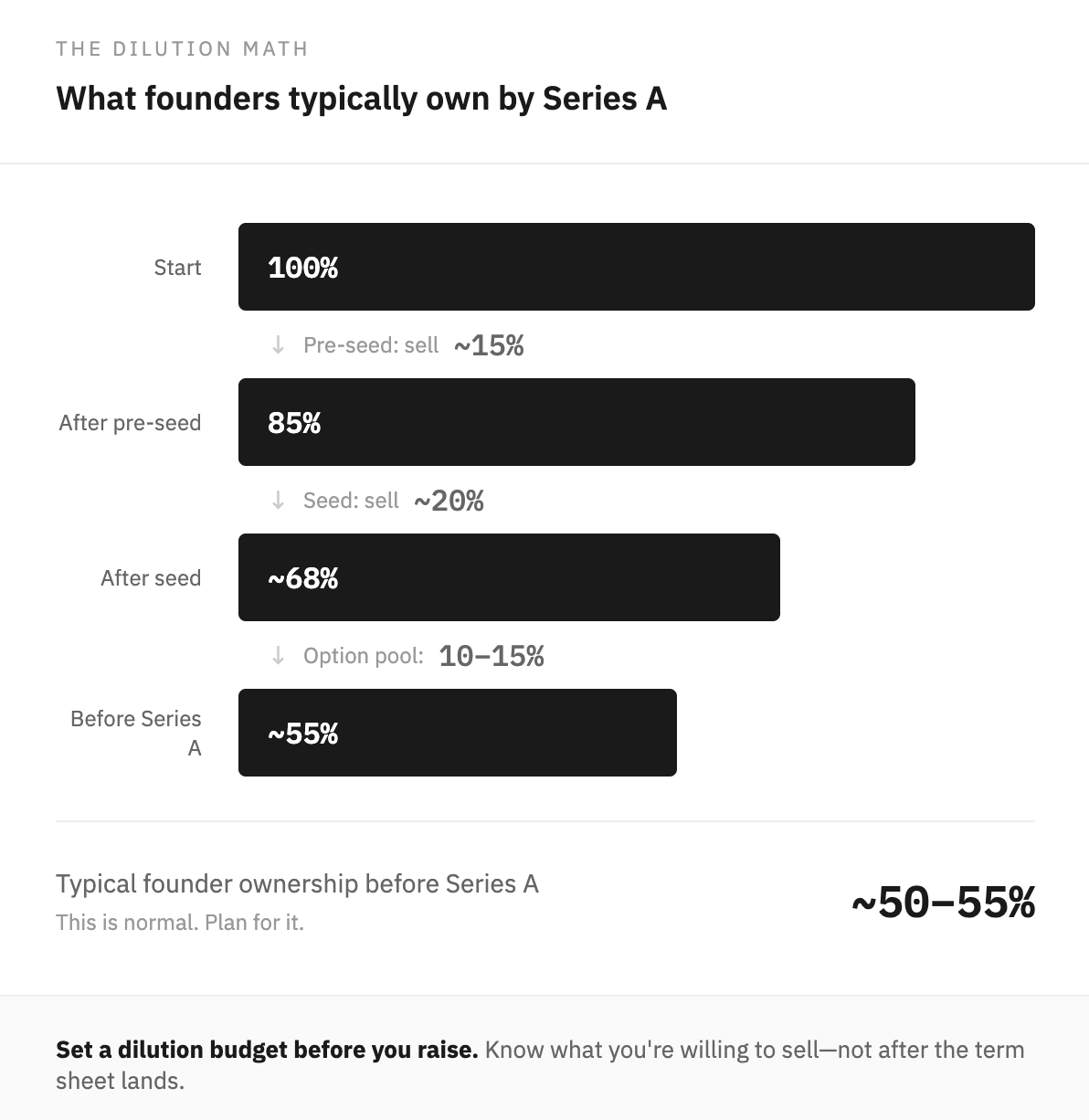
So build a dilution budget. Decide what you're willing to sell before Series A, then work backward.
If you sell 15% at pre-seed and 20% at seed, you're at ~35% dilution before Series A even starts. Add an option pool refresh, and founders often hold around 50% by the time they close their A.
A simple stage test
It's pre-seed if:
- Wedge still changing
- Buyer not consistent
- Onboarding is custom
- Roadmap depends on "after we raise"
It's seed if:
- Wedge stable
- Buyer clear
- Onboarding repeats
- Product has a default path
- You can hire into a plan
Pre-seed is for finding the right startup. Seed is for building the startup you already found.
Tags
- Pre-seed
- Seed Funding
- idea validation
- SAFEs
About the author
Zeeshan Ali, Co-Founder
Co-founder at Platvix, building an investment intelligence platform and the ecosystem around it so founders become investment-ready faster and VCs make stronger decisions. I focus on operations, partnerships, and community building, turning strategy into execution through programmes, processes, and founder support.