
Data infrastructure is what makes your startup hard to replace
Strategies and insights for building defensible, acquisition-ready startups.
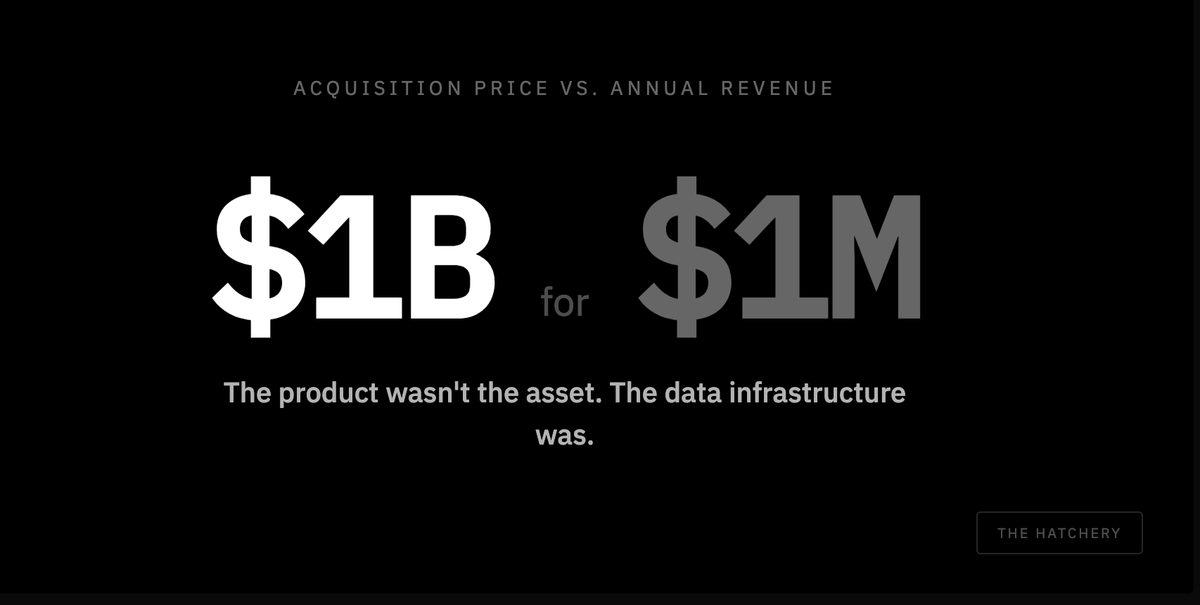
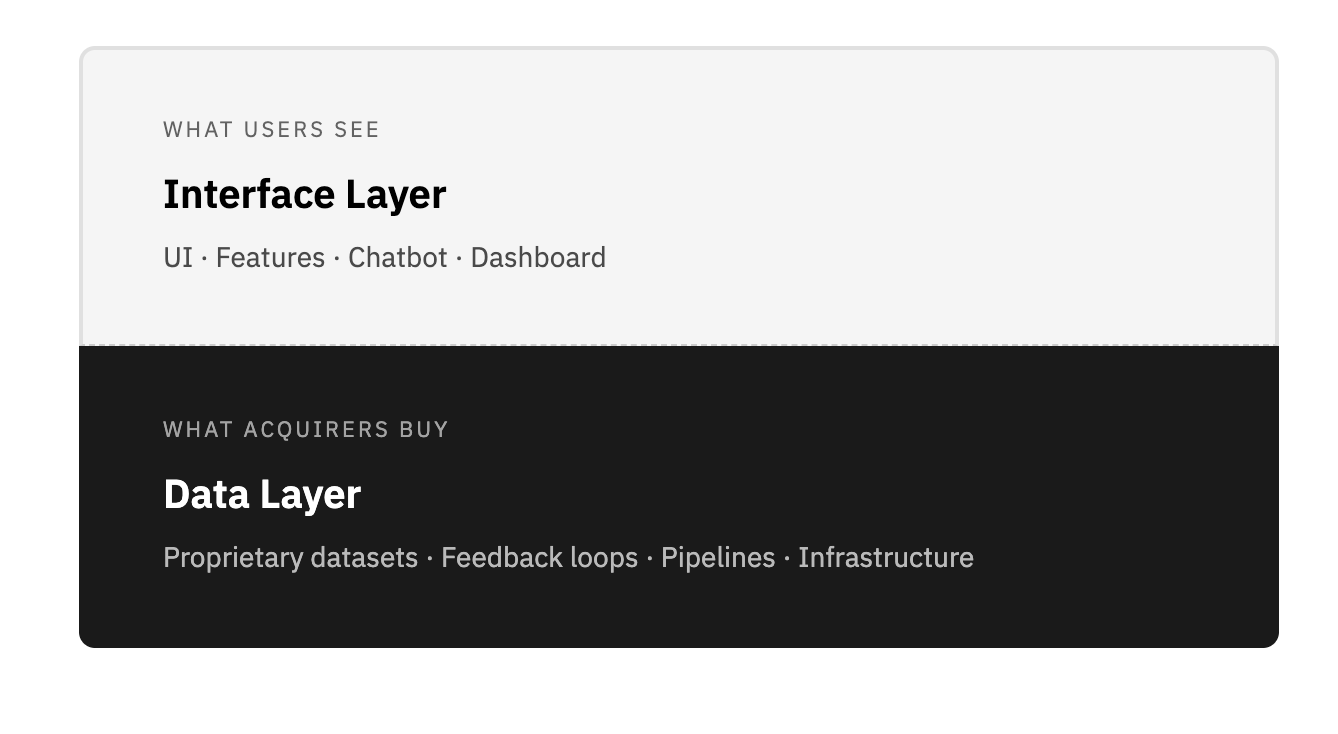
Most AI startups won't get acquired for their interface. They'll get bought for what's underneath it.
The model layer is increasingly accessible. OpenAI, Anthropic, open-source. Most teams are building on shared foundations. That doesn't mean product and distribution don't matter. They do. But when acquirers write large checks, they're often paying for something else.
They're paying for the data layer.
Scene 1: The data you're collecting
Big companies have models. What they often lack is your vertical.
A startup building for legal, healthcare, or logistics is sitting on domain-specific data that took months to collect, clean, and structure. That dataset is hard to replicate. It's also exactly what a larger player needs to enter that market fast.
The product might be "contract review." The asset is 50,000 tagged legal documents and the schema that organizes them.
Scene 2: The feedback loops
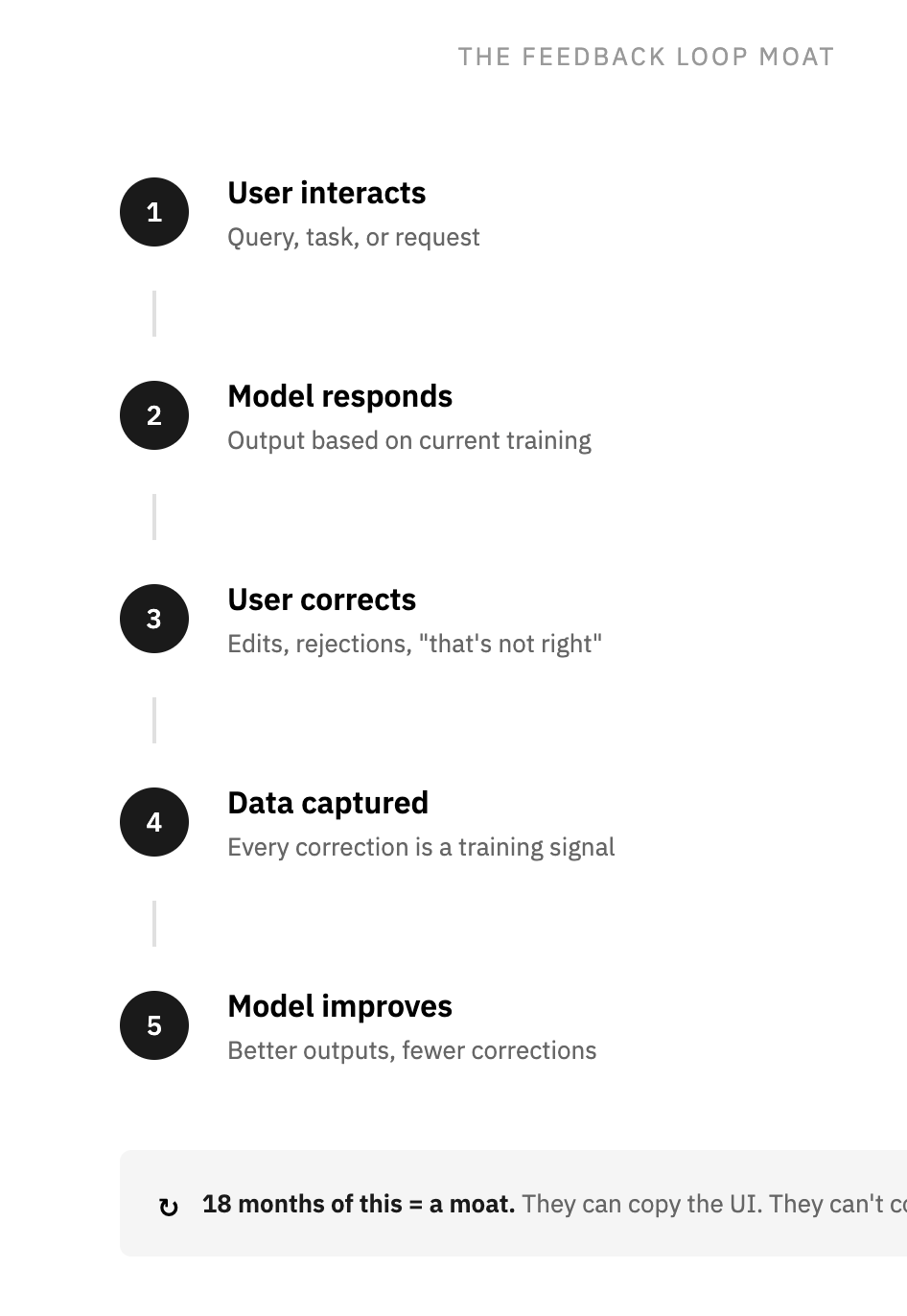
Every user correction is a data point. Every edit, every rejection, every "that's not right." It feeds back into the system.
This is what makes a product improve after launch, not before. And it's hard for an acquirer to replicate. They can copy the UI. They can't copy 18 months of real-world usage patterns.
Scene 3: The pipes themselves
How data moves through the system matters. Ingestion. Tagging. Validation. Storage. Retrieval.
None of it is exciting. All of it is expensive to rebuild.
This pattern is already showing up in deals. In 2024, Databricks paid over $1 billion for Tabular, a data management company with only $1 million in annual revenue. The value wasn't in the product. It was the team that created Apache Iceberg and the data infrastructure expertise they built. Snowflake acquired Datavolo for its data pipeline automation capabilities. Databricks also bought Lilac, a startup focused on data quality for generative AI.
The pattern is consistent: acquirers are paying for data infrastructure, not interfaces.
The thread that connects all three scenes
Not every acquisition follows this script. Some are product-led. Some are distribution plays. But in many cases, especially acqui-hires, the product gets sunset. What stays is the data and the team that built the infrastructure.
The moat was never the chatbot. It was the backend no one sees.
The simple move for this week
Look at your stack and ask: what are we building that would be hard to rebuild?
- A proprietary dataset
- A feedback loop that's already running
- A pipeline tuned to a specific vertical
If the answer is "nothing yet," that's the gap. Treat your data layer like a product. To an acquirer, it already is one.
Tags
- Data Infrastructure
- AI Startups
- Acquisitions
- Startup Moats
About the author
Zeeshan Ali, Co-Founder
Co-founder at Platvix, building an investment intelligence platform and the ecosystem around it so founders become investment-ready faster and VCs make stronger decisions. I focus on operations, partnerships, and community building, turning strategy into execution through programmes, processes, and founder support.